
Family tree charts: the six kinds, and how to choose one

A family tree chart, also called a genealogy chart or family history chart, is a diagram of a family drawn to a fixed plan, so anyone can read who is whose parent, child or partner. Each kind of chart follows a different plan. Some look back at your ancestors, some look forward to everyone who came after a couple, and some record a single family in detail. Pick the chart by the question you want it to answer.

The six kinds of family tree chart

In each drawing below, a box is a person and the gold box is the person the chart is about.

Pedigree chartFour columns of boxes. One box on the left, for you, joins two boxes for your parents, which join four grandparents and then eight great-grandparents on the right.

Pedigree chart

Also called an ancestor chart

What it shows
Your direct ancestors and no one else: you, your two parents, four grandparents, eight great-grandparents, doubling with every generation. Brothers, sisters and cousins are not on it.
When to use it
When you are researching your ancestry and want to see at a glance which ancestors you have found and which boxes are still empty. It is the chart most genealogists start with.
On one page
Four or five generations on a sheet of Letter or A4: 15 people for four, 31 for five. Past that the boxes get too small to write in, so researchers number each person and carry the line on to a new sheet.
At Roots We PlantedWe print this
We print it: choose Ancestors on the Look step. The chart reads upward, with the person at the bottom and each generation of parents above, on a portrait or landscape sheet.
Descendant chartA couple at the top, joined by a line to their three children, with the children’s own children on the rows below.

Descendant chart

Also called a descendancy chart

What it shows
One person or couple at the top and everyone who came from them: children, grandchildren and on down, usually with each descendant’s husband or wife beside them.
When to use it
For a family reunion, a book about one ancestor’s family, or to show a grandparent everyone who came after them.
On one page
It depends on the family, because the chart widens with every child. A small family fits on one page for three or four generations; a large one needs a poster or several sheets long before that.
At Roots We PlantedWe print this
We print it: choose Descendants. The person or couple sits at the top, with their children, grandchildren and on down below.
Fan chartA half circle. You fill the small half disc at the centre; around it, rings split into 2, 4, 8 and 16 sections, one for each ancestor.

Fan chart

Also called a circular or half-circle chart

What it shows
The same people as a pedigree chart, your direct ancestors, set in a half circle: you at the centre and each generation in a wider ring around you.
When to use it
When you want many generations in a small space, or a picture of which branches you have researched furthest. The empty wedges show the gaps at once.
On one page
More than a pedigree chart on the same paper, because the outer rings have room to spare. FamilySearch prints a seven-generation fan chart on a single page.
At Roots We PlantedNot offered
We don’t print fan charts. Our prints draw the tree in rows, with a card for each person that has room for a portrait, dates and places.
Hourglass and bowtie chartsA couple in the middle. Above them, each partner’s parents; below them, their three children and some of their grandchildren.

Hourglass and bowtie charts

Two ways to put a couple in the middle

What it shows
An hourglass chart puts one person or couple at its waist, with their ancestors above and their descendants below. A bowtie chart is a couple’s pedigree: one partner’s ancestors spread out to the left, the other’s to the right.
When to use it
When the story is about the middle generation: a couple’s anniversary, or a gift that shows grandparents both where they came from and who came after them.
On one page
It grows in two directions, so it needs more room than either half alone. How many generations fit depends on how many children and grandchildren there are below.
At Roots We PlantedWe print this
We print the hourglass: choose Both. We don’t print a bowtie. The closest is a couple print with Ancestors, which draws each partner’s ancestors above them rather than out to the sides.
Family group sheetA form. Two boxes at the top for the husband and the wife, then a table with a row for each of their children.

Family group sheet

A research form, not a tree

What it shows
One family on one page: a couple, with the dates and places of their births, marriage and deaths, their parents’ names, and a row for each child.
When to use it
As a research record. Genealogists keep one sheet per couple, note the source of every fact, and link the sheets to a pedigree chart by number.
On one page
Three generations of names for one family: the couple, their parents and their children. It records a family in detail rather than showing a whole tree.
At Roots We PlantedNot offered
We don’t print family group sheets. They are working records, kept in a binder rather than hung on a wall.
Cousin chartA grid. The common ancestor sits in the top left corner; a path runs along one row and up one column to the highlighted cell that names the relationship.

Cousin chart

Also called a relationship chart

What it shows
Not a tree but a grid. Put the common ancestor in the corner, count how many generations each person is from them, and the cell where the row and column meet names the relationship: second cousin, first cousin once removed, and so on.
When to use it
When you meet a relative at a reunion or in a list of DNA matches and want to know exactly how you are related.
On one page
One page covers the relationships most families meet: first, second and third cousins, once or twice removed.
At Roots We PlantedNot offered
We don’t print a relationship chart; our free cousin calculator does the counting for you. Cousins can still be on a print: if they are cards on your tree, the print draws them under their parents.
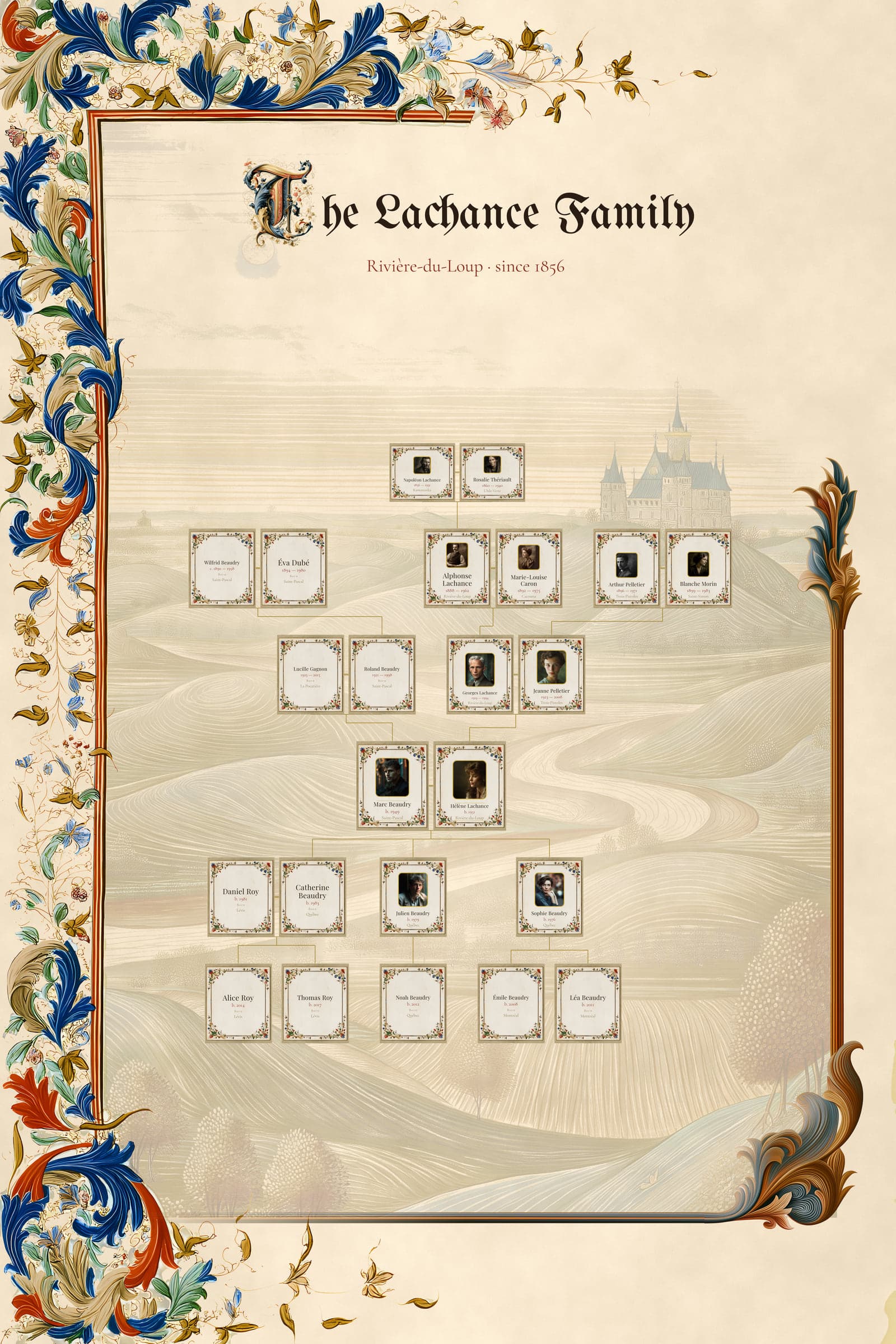
Sample wall print of the Lachance family in the Illuminated Manuscript style: portrait cards for a couple, three generations of ancestors above them and their children and grandchildren below, inside a painted floral border.
A sample print for a fictional family, Illuminated Manuscript style, 24×36 inches. This is Both: Marc and Hélène in the middle, their ancestors above, their children and grandchildren below.

Which charts Roots We Planted prints

Roots We Planted is a family chart maker for the wall. You build your tree here or import it, then choose what the print shows around one person or couple. There are three choices, and each one is a classic chart.

  • AncestorsA pedigree chartThe person at the bottom, each generation of parents rising above.
  • DescendantsA descendant chartThe person or couple at the top, with their children, grandchildren and on down.
  • BothAn hourglass chartAncestors above, children and grandchildren below, with their partners.
  • Not offeredFan charts, bowtie charts, family group sheets and cousin relationship charts.

Every print has a card for each person, drawn in one of eight illustrated styles. Brothers and sisters kept as a list on your tree print as a list beside their family. You choose how many generations to show, and the print comes in 16×20, 24×36, and 40×60 inches. The Print step marks the smallest size on which every name stays readable.

See the eight styles

Drawing a family tree by hand

You need a large sheet of paper, a pencil, a ruler and an hour with whoever remembers the family best. Start with a pedigree chart: its shape is fixed, so you can plan the page before you write a single name.

  1. Write down what you know first

    List names, dates and places on scrap paper before you draw anything. Ask parents and grandparents, and look at birth, marriage and death certificates.

  2. Put yourself on the left

    Turn the sheet sideways. Draw one box near the left edge, halfway down, for yourself.

  3. Give every person two boxes to the right

    Father above, mother below. Each new column holds twice as many boxes in the same height, so space them before you draw.

  4. Join them with brackets

    Run a short line from each person to a bracket that reaches both parents. Straight, ruled lines keep a crowded chart readable.

  5. Write names and dates in pencil

    Full name, with women under their maiden name, then the years of birth and death. Pencil, because you will correct things.

  6. Leave the gaps empty

    An empty box is a question to ask, not a space to fill with a guess. Mark anything you are unsure of with a question mark.

Questions about family tree charts

What is the difference between a pedigree chart and a descendant chart?

They run in opposite directions. A pedigree chart starts with one person and goes back through their parents, grandparents and further, so it shows ancestors only. A descendant chart starts with an ancestor and comes forward through their children and grandchildren. Use a pedigree chart to research where you come from, and a descendant chart to show everyone who came from one couple.

How many generations fit on one page?

On Letter or A4, a pedigree chart holds four or five generations: 15 people for four, 31 for five. A fan chart holds more, because its outer rings have room; FamilySearch fits seven. A descendant chart depends on the size of the family. For more generations, use a larger sheet or carry the line on to a new page.

Free pedigree chart template

What is a fan chart?

A fan chart is a pedigree chart drawn as a half circle: you at the centre, your parents in the first ring, your grandparents in the next, and so on outward. It fits more generations in less space, and the empty wedges show which lines still need research. Roots We Planted does not print fan charts.

Can I print my Ancestry or FamilySearch tree as a chart?

Yes. Export your Ancestry tree as a GEDCOM file and import it here; everyone in the file comes in. FamilySearch Family Tree has no GEDCOM download, so you either bring it through free desktop software that writes a GEDCOM file, or build the tree here and add people from a PDF of FamilySearch’s pedigree chart. Then choose Ancestors, Descendants or Both, and order the print.

How to print your family treeGEDCOM viewer

How big should a family tree wall chart be?

Big enough that every name can be read from where people will stand. Our prints come in 16×20, 24×36, and 40×60 inches. We lay your tree out at each size and mark the smallest one on which every name stays readable, and the smallest sheet is refused when the names would come out too small.

Print prices

Can a family tree chart show cousins?

A pedigree chart can’t, because it shows direct ancestors only. A descendant chart drawn from a grandparent shows all of their grandchildren, who are first cousins to one another. On our prints, cousins who are cards on your tree are drawn under their parents. To name an exact relationship, such as second cousin once removed, use a cousin chart or our cousin calculator.

Cousin calculator

Start the tree your chart is drawn from

Start a family tree online with up to 2 generations and 20 people, no card required. When it is ready, choose Ancestors, Descendants or Both and see the print before you order it.